Arabian Sea
The Satanic VersesThe Arabian Sea is the promised threshold at the end of the Titlipur pilgrimage: the place where the kahin says the waters will part and the pilgrims will cross the ocean floor toward Mecca. It becomes the journey’s actual terminus, but not its promised passage. When the pilgrims walk into the water, they are never seen again, leaving survivors and authorities to reckon with a disappearance that resists a single explanation.
The Sea as Destination
At an emergency meeting of the Titlipur panchayat, the kahin announced that the villagers were commanded to make a pilgrimage to Mecca, passing through the Arabian Sea. She said they would walk to the shore, enter the foam, and find the waters opening before them. The sea thus stood both for a physical destination and for the decisive sign by which the pilgrims’ faith would be tested.
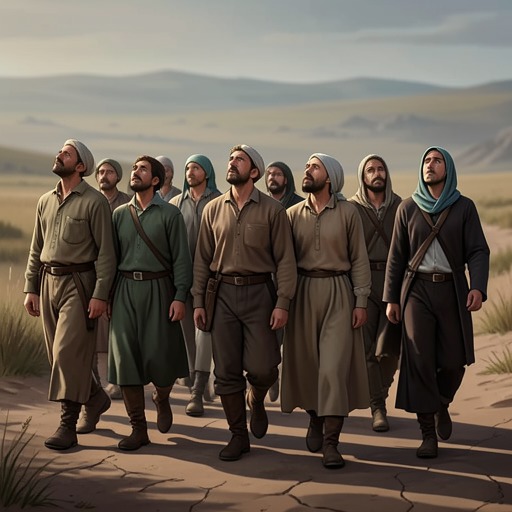
The march was organized as a collective undertaking, not a journey reserved for the strong or wealthy. The panchayat decided that nearly everyone, including the old and infirm, would walk; only the youngest infants were exempt, and adults would carry them in rotation. The later account describes the sea as about 150 miles away and estimates the journey at eleven weeks, at a pace of roughly two miles a day. That practical, difficult route led toward a destination whose promised crossing belonged to the realm of revelation.
A Public and Contested Shore
As the pilgrimage moved south through drought-stricken country, the Arabian Sea acquired a troubling practical meaning as well as a sacred one. Mirza Saeed Akhtar argued that salt water could not save people searching for drinking water, while the pilgrims continued toward the shore in expectation of a miracle. The contrast set urgent material need against the promised transformation of the sea.
By the ninth week, the march had become a national spectacle. Journalists, politicians, commercial sponsors, tourists, and other onlookers gathered around the pilgrims; photographs of the kahin appeared in newspapers, and her butterfly-covered appearance unsettled visitors’ assumptions. Religious extremists also denounced the pilgrimage as a provocation and contested its public meaning. The route to the Arabian Sea therefore passed through an argument over who could claim religious traditions and how a mass religious procession should be understood.
Arrival at the Coast
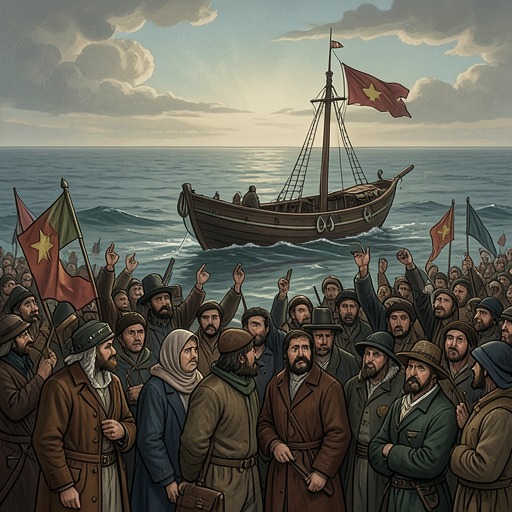
The pilgrims reached the sea through a crowded urban shoreline. They passed the Holiday Inn, luxury apartment balconies, beachgoers, and people working or gathering on the sand before seeing the Arabian Sea. The setting brought the extraordinary procession into contact with ordinary city life: the sacred destination was also a public beach, observed by residents and visitors.
By then Mishal Akhtar was too weak to stand without support, and two villagers helped her as the group approached the water. Mirza Saeed Akhtar saw her beside the kahin and briefly imagined the prophetess as having emerged from the dying woman; he then recognized that he, too, was being drawn into the pilgrimage’s supernatural atmosphere. His response registers the uncertainty surrounding the shore before the prophecy’s final test.
The Crossing and Its Aftermath
The pilgrims entered the Arabian Sea, but the waters did not visibly open for them. The kahin, Mishal Akhtar, and the villagers of Titlipur went below the surface and were never seen again. The account emphasizes the incomprehensible nature of their forward movement into the water, without resolving whether the event should be read as miracle, catastrophe, or both.
Mirza Saeed Akhtar, Osman, Srinivas, Sarpanch Muhammad Din, and Mrs. Qureishi rushed into the sea. The last four were brought back to shore; Mirza Saeed continued diving farther out and for increasingly long periods before he, too, was rescued, exhausted and ill. The pilgrimage was over. He woke in a hospital with a Criminal Investigation Department officer beside him: the authorities were considering whether the survivors could be charged with attempted illegal emigration and sought their accounts before they could confer. The Arabian Sea thus closes the pilgrims’ journey while opening a new dispute over how their disappearance and the survivors’ testimony might be classified.